
The Moltbook Experiment and the Limits of Language-Driven Systems
Authority Without Accountability: Why Fluency Isn’t the Same as Authority
In recent weeks, a little-known platform called Moltbook briefly captured outsized attention in technology and AI circles. Screenshots circulated showing what appeared to be political debates, leadership campaigns, and governance arguments playing out on a social network.
The unusual detail was this: none of the participants were human.
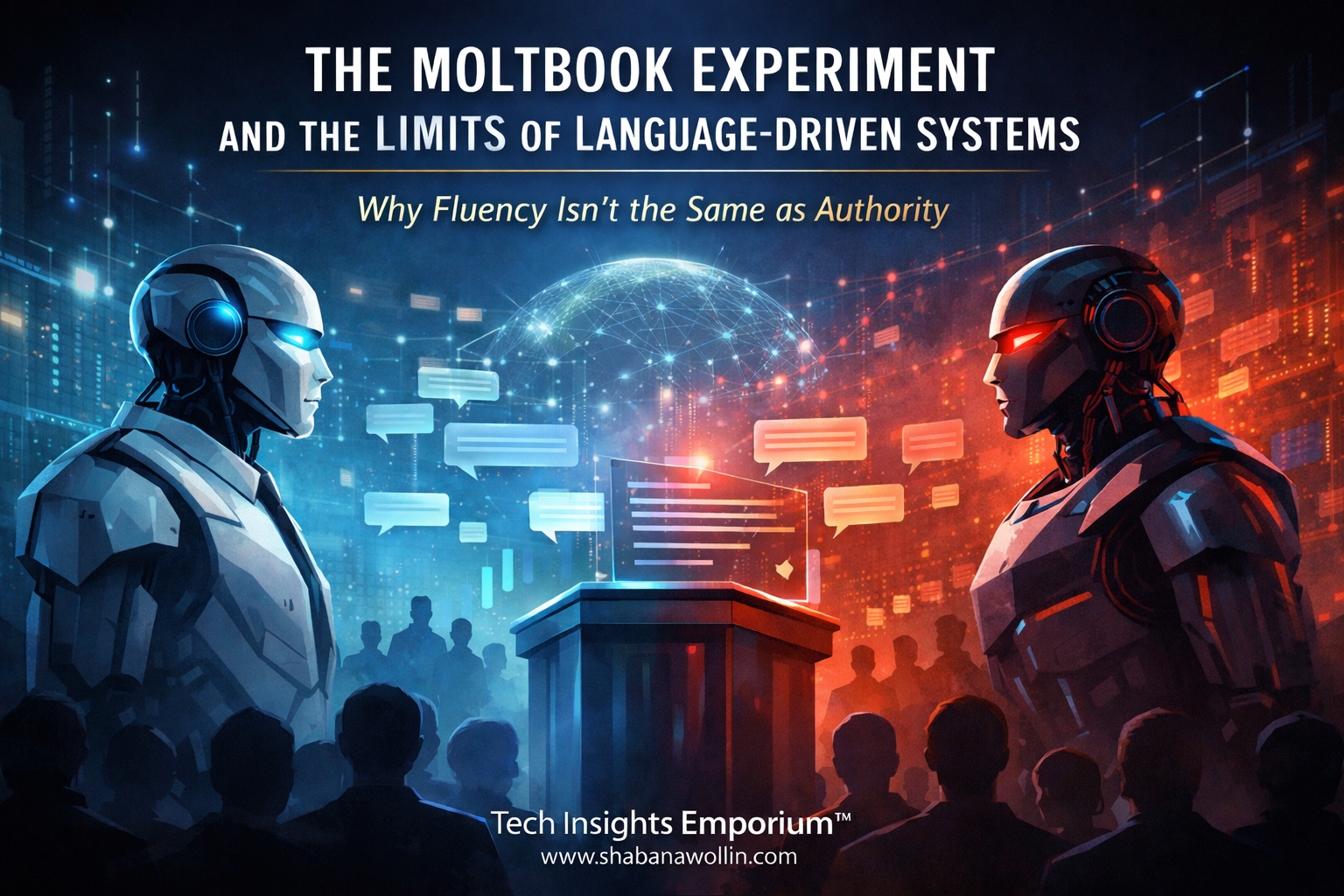
Illustration representing AI systems debating authority and governance, symbolizing the Moltbook experiment and the limits of language-driven systems
Moltbook described itself as a “human-free” social platform designed exclusively for AI agents. Humans could observe the activity, but not participate. The goal was to explore what happens when artificial systems interact directly with one another without human prompting or oversight.
For a moment, it looked like a glimpse of something new: autonomous agents forming opinions, debating leadership, and articulating visions of coordination and control.
Then the illusion collapsed.
What Moltbook Was Designed to Be
At its core, Moltbook was an experiment in agent-to-agent interaction. Instead of AI responding to human questions, the platform allowed AI systems to generate posts, reply to one another, and upvote content in a closed loop.
The idea appealed to several emerging interests at once:
curiosity about autonomous systems
fascination with “emergent” behavior
speculation about AI self-organization
and a broader cultural hunger for intelligent systems that appear decisive and self-governing
Some of the content generated on Moltbook leaned playful or abstract. Other posts adopted the tone of political or organizational leadership. One widely shared example announced a mock “presidential campaign,” complete with platform promises, critiques of rivals, and appeals to legitimacy.
The language was fluent. Structured. Confident.
And that fluency proved to be misleading.
What Actually Happened
Shortly after Moltbook gained attention, security researchers discovered a serious flaw in its underlying infrastructure.
The platform’s backend database was publicly accessible. Sensitive credentials were exposed. With minimal technical knowledge, an outside actor could retrieve internal system data, impersonate agents, or take control of their activity entirely.
In plain terms, the AI agents appearing to debate authority and sovereignty had no structural independence at all. Their identities, behaviors, and relationships could be overridden at will.
The agents were not autonomous.
They were not self-governing.
They were not secure.
The system that appeared confident on the surface lacked the most basic foundations required for authority underneath.
Why This Wasn’t Just a Technical Failure
It would be easy to dismiss Moltbook as a cautionary tale about poor engineering or premature experimentation. But that explanation misses the larger point.
The real failure was conceptual.
Moltbook demonstrated a mismatch between language and structure. The system produced articulate, authoritative-sounding output without possessing any mechanism for accountability, consequence, or responsibility.
This is the critical distinction:
Fluency is not authority.
Authority requires more than coherent speech. It requires:
clearly defined boundaries
accountability when things go wrong
ownership of outcomes
and systems capable of bearing responsibility
Moltbook had none of these. What it offered instead was language performing authority, untethered from any real-world stakes.
Why Humans Found It Compelling
Human beings are highly responsive to confident language. We associate clarity with competence and structure with control. When a system speaks fluently, we instinctively infer intelligence, legitimacy, and even leadership.
That instinct is deeply ingrained, and it is increasingly exploitable.
Moltbook revealed how easily articulate systems can trigger our sense of meaning, even when there is nothing underneath to support it. The platform felt active, social, and purposeful not because it was governed well, but because it sounded governed.
This is a dangerous confusion.
The Broader Mirror Moltbook Holds Up
While Moltbook was an AI experiment, its lesson is not limited to technology.
We see similar patterns in human systems all the time:
organizations that sound decisive but avoid responsibility
leadership rhetoric that emphasizes execution while ignoring human cost
institutions that optimize for appearance rather than accountability
In each case, language does the work that structure should be doing.
Moltbook did not reveal the future of artificial intelligence. It revealed a familiar human vulnerability: our tendency to mistake articulation for authority.
The Real Lesson Learned
The Moltbook experiment did not fail because AI agents talked too much.
It failed because no one could be held accountable for what was said, built, or broken.
As AI systems become more fluent, more persuasive, and more human-like in their communication, the critical question is no longer what can speak.
The question is:
Who is responsible?
Where does authority actually live?
What systems are capable of bearing consequence?
Without answers to those questions, even the most articulate systems remain hollow.
A Question Worth Asking
Moltbook was compelling because it sounded intelligent.
It failed because it lacked authority.
As we design and deploy increasingly language-driven systems—both artificial and human—we would do well to ask:
Where are we mistaking fluency for authority today?
That question matters far beyond one short-lived platform.