
Why Data, AI, and Decision Intelligence Are Redefining the Role of the Physical Store
The silent Shift in Retail
For more than a decade, retail strategy has been shaped by the promise of experience. Stores became stages. Brands invested in sensory design, immersive layouts, and moments meant to be remembered and shared.
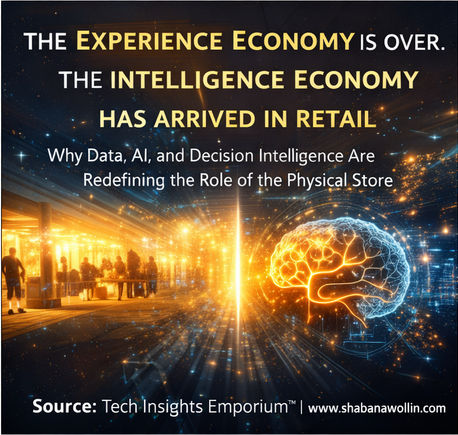
That era is not disappearing—but it is no longer decisive.
In 2026, retail advantage is no longer created by experience alone. It is created by intelligence: the ability to sense behavior in real time, interpret signals at scale, and act decisively across physical and digital environments. The retailers pulling ahead are not those with the most engaging stores, but those with the most adaptive systems.
The experience economy has reached maturity.
The intelligence economy has arrived.
Experience Was the Transition. Intelligence Is the Destination.
Experiential retail solved an important problem: it re-humanized shopping in a digital-first world. But experience, by itself, does not compound. It does not learn. And it does not adapt unless intelligence is embedded beneath it.
What’s emerging now is a different operating model.
Retailers are shifting from designing moments to designing decision systems. From optimizing touchpoints to optimizing outcomes. From static store formats to responsive environments that evolve with customer behavior, supply dynamics, and market conditions.
Experience still matters—but it is no longer the strategy. It is the expression of one.
The Physical Store Is Becoming an Intelligence Node
Contrary to years of speculation, the physical store is not disappearing. It is being repurposed.
In leading retail organizations, stores are increasingly treated as data-rich environments:
Capturing behavioral signals
Informing inventory and assortment decisions
Enabling real-time personalization
Feeding AI-driven forecasting and pricing models
Sensors, computer vision, smart carts, associate-facing AI tools, and unified commerce platforms are turning stores into learning systems, not just destinations.
The store’s value is shifting from what it displays to what it detects.
From Omnichannel to Unified Intelligence
Omnichannel once meant consistency across channels. In the intelligence economy, it means coherence across systems.
Retailers are investing heavily in:
Unified data architectures
Real-time analytics layers
AI-driven decision engines that span merchandising, marketing, and operations
This allows organizations to close the loop between insight and action. Intelligence no longer lives in dashboards reviewed weeks later. It operates continuously, influencing pricing, promotions, staffing, and fulfillment as conditions change.
The competitive gap is widening between retailers who integrate intelligence and those who merely visualize data.
Intelligence as Retail’s New Competitive Advantage
What distinguishes intelligence-led retailers is not technology adoption, but how intelligence is operationalized.
Leading organizations are integrating the following 4 practices into AI to:
Anticipate customer demand rather than react to it
Model second- and third-order effects of decisions
Detect early signals of consumer behavioral and market shifts
Reduce bias in planning and forecasting
This is not automation for efficiency alone. It is intelligence for strategic leverage. Retail advantage is no longer built on scale or footprint. It is built on learning velocity.
The Leadership Implication
This shift carries a profound implication for retail leadership.
The central question you must ask is no longer: “How do we create better experiences?”
It has shifted to: “How do we design systems that continuously learn, decide, and adapt faster than the market?”
Experience without intelligence becomes ornamental. Intelligence without experience becomes alienating.
The future belongs to organizations that integrate both—where experience is informed by real-time understanding, and intelligence is applied with human context.
Designing for What Comes Next
Retail is not ending. It is evolving.
The intelligence economy does not replace experience; it subsumes it. It reframes the role of the store, the function of data, and the responsibility of leadership. For retail organizations willing to invest beyond surface-level transformation, the opportunity is significant. The question is no longer whether intelligence will shape retail’s future—it already is.
The real differentiator is whether leadership chooses to design for it.
What Retail Leaders Can Do Next
The shift from experience to intelligence is already underway. The question for retail leaders is not whether this transition will happen—but whether their organizations are prepared to lead it. If you’re rethinking the role of physical stores, data, and AI in your retail strategy, now is the moment to move from observation to design.
Explore how intelligence-led frameworks can help you assess readiness, identify strategic blind spots, and architect what comes next.
Subscribe to Tech Insights Emporium™ for ongoing insights on retail intelligence, AI strategy, and the future of enterprise decision-making.